The
Treaty That Wasn't: Foreign Policy Under the Confederation
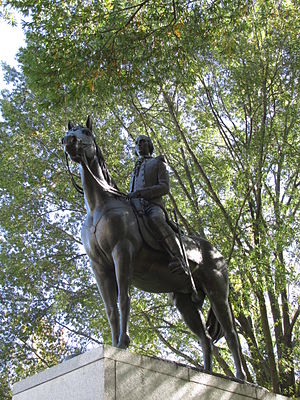 In
2014, the United States Congress conferred honorary American
citizenship upon Bernardo de Galvez (left), 228 years after his
death.
He became the eighth person so honored, joining such luminaries as
Winston Churchill, Mother Teresa, Lafayette, and Casimir Pulaski.
In
2014, the United States Congress conferred honorary American
citizenship upon Bernardo de Galvez (left), 228 years after his
death.
He became the eighth person so honored, joining such luminaries as
Winston Churchill, Mother Teresa, Lafayette, and Casimir Pulaski.
Who
was Galvez, and what had he done? During the Revolutionary War, he had
fought on behalf of Spain, which was fighting Great Britain at the same
time as, although independently of, the United States. Galvez
had
driven the British out of the Gulf Coast and the southern Mississippi
Valley.
And in so
doing, he dropped a foreign policy problem
into
the lap of the Congress which met under the Articles of Confederation,
which threatened to sunder the country into east versus west as well as
north versus south, and forced a reexamination of centuries-old
treaty-making practice.
Spanish
settlers began living in what is now the southern United States in
1565, when Pedro Menendez de
Aviles founded St. Augustine. The settlers called their
colony La
Florida. By the Eighteenth Century, it had boundaries roughly
congruent with the present-day state, with a westernmost outpost at
Pensacola. The Spaniards occasionally
crossed
swords with the southern British colonies, so Great Britain seized
Florida as part of the settlement (1763) which ended the Seven Years
War. Spain was compensated (at the expense of France) with
sovereignty over Louisiana, including the west bank of the Mississippi
River and a small area surrounding New Orleans at the river’s
mouth. However, the peace treaty required that Spain allow
British ships to transit New Orleans and trade up and down the
Mississippi River.
Great
Britain joined the former Spanish colony with Gulf Coast territory
seized from the French, and split it into eastern and western halves.
East Florida
included the peninsula which makes up most of the present state (see
top map at right).
West
Florida
ran west to the Mississippi River and north to
what is
now Vicksburg, Mississippi. Much of both Floridas was still
controlled by American Indians, notably the Creeks and Choctaws.
European settlers lived almost entirely along the seacoast and major
rivers.
After the British takeover, most Spanish settlers decamped for
Cuba; most French settlers remained and were joined by a slowly
increasing trickle of Britons. Settlers from all three European
countries were of course accompanied by those they had enslaved,
who had no choice in the matter.
 For the next 15 years, Britain governed East and West Florida as its 14th and 15th American colonies. During
the American Revolution, the settlers did not rebel, and would have
been happy to remain British subjects. Spain, however, saw an
opportunity to regain its former colony—and maybe more. Spain deputized Galvez, the governor of Spanish Louisiana, to do
so. He drove the British out of West Florida (1779-81),
relieving British pressure on the southern American
states. By the end of the Revolutionary War (1783), it was
obvious the British would have to abandon East Florida as well.
For the next 15 years, Britain governed East and West Florida as its 14th and 15th American colonies. During
the American Revolution, the settlers did not rebel, and would have
been happy to remain British subjects. Spain, however, saw an
opportunity to regain its former colony—and maybe more. Spain deputized Galvez, the governor of Spanish Louisiana, to do
so. He drove the British out of West Florida (1779-81),
relieving British pressure on the southern American
states. By the end of the Revolutionary War (1783), it was
obvious the British would have to abandon East Florida as well.
Americans
offered
Galvez moral support, and even a little military support in the form of
American volunteers who joined his expedition.
However, the United States and Spain left
one matter
hanging—how much territory would Spain regain after the war? In general, Americans were
satisfied to see
Spain retain the Florida peninsula and the Gulf coast, which weren’t in
the
path of western expansion. But,
Spain
wanted more.
The British negotiated
separate peace treaties (1783) with the United States and Spain.
Great Britain would abandon her 15 American colonies--but to
whom? To the Americans, Britain ceded everything east of
the Mississippi and south of Canada down to the 31st
parallel—including part of the land they had been governing as West
Florida. And, Great Britain transferred her treaty right to
navigate the Mississippi to the United States. To Spain,
Britain ceded “Florida”
without delineating its boundaries.

Spain
scoffed at Britain’s pretension in establishing boundaries (in the
American treaty) over territory she no longer
controlled, and scoffed even harder at the notion that Britain’s right
to navigate the Mississippi was a “bearer certificate” that could be
transferred without Spanish approval. Spain claimed all of both
Floridas, and a great deal of further territory east of the Mississippi
(see shaded area on bottom map), as a result of Galvez’s conquests.
The boundary
between Spain and the United States, she asserted, would be negotiated
between those two countries alone. And, Spain (1784)
interdicted
American commerce on the Mississippi.
Thus
it was that Don Diego de Gardoqui, a Spanish diplomat with a
background—unusual for the Spanish court—in commerce and finance,
showed up in New York in 1785 to negotiate with American diplomats, who
would be appointed and instructed by Congress. The two sides
would attempt to resolve the boundary and navigation issues dividing
the two countries.
The
earliest
Continental Congresses, meeting in 1774 and 1775, did not think of
themselves
as conducting foreign policy. They
were attempting to address grievances with Great Britain, which
was not
then a foreign country. It
was the
estranged Mother Country.
As the
Revolutionary War gathered steam and Congress edged toward
independence,
the delegates began to take a wider view of the world.
John Adams wrote in October 1775, “Suppose We
assume an intrepid Countenance, and Send Ambassadors at once to foreign
Courts.
What Nation shall We
court? Shall We go
to the Court of France, or the Court of Spain, to the States General of
the
United Provinces? . . . If We Should is there a Probability, that Our
Ambassadors would be received, or so much as heard or seen by any Man
or Woman
in Power at any of these Courts?” By
fall 1775, Congress was sending unofficial emissaries to Europe to find
out.
With
independence
in 1776, matters came out into the open.
Congress dispatched Benjamin Franklin and others to France
to seek a
treaty of commerce, a military alliance, and cash loans, and these
efforts bore
fruit in 1778. The
war with Great
Britain now became a matter of foreign policy as well, and when the
British
indicated receptivity to peace talks, Congress sent commissioners there
to negotiate.
The drafters of the Articles of
Confederation (1776-77), as members of Congress, limited
their own power over domestic
affairs, but made certain to retain plenary control over foreign
policy. Congress, per
Article IX, would exercise “the
sole and exclusive power” of declaring war and making peace, sending
and
receiving ambassadors, and entering into treaties and alliances with
foreign
countries. A
declaration of war, or a
treaty or alliance, could not come into effect “unless nine states
assent to
the same”—that is, two thirds of the total.
The lodging
of
these powers in a legislative body (Congress) represented a departure
from
European practice, under which ambassadors typically acted as personal
representatives of their monarch.
Monarchs were expected to ratify, more or less automatically, any
treaty
negotiated in good faith by their ambassador, since to do otherwise
would
repudiate the work of their own representative.
Congress, on the other hand, would appoint and instruct ambassadors as
a
group, and her membership might change between when a treaty was
negotiated and
when it was ratified. What standards
would apply? This remained to be worked
out.
The
Articles were
ratified in 1781, and peace came in 1783.
With the coming of peace, American foreign policy objectives
evolved.
Congress still required loans (see Finances),
and wished to
negotiate easier terms for the repayment of earlier loans.
But now, as well, Congress needed to solve
the boundary dispute with Spain. And in addition,
Congress wished to secure commercial
agreements,
establishing terms of trade, with as many European countries as
possible.
Americans were already trading with
foreign countries, commercial
agreement or no. In one famous example, a syndicate of
American
merchants sent a trading ship to China in 1784, and made money despite
the lack of a prior trade agreement--or any prior
contact--between America and China.
Operating
outside
of a commercial agreement, however, entailed risk for
merchants. Foreign governments might suddenly close
ports or forbid trade in certain articles, or raise tariffs and harass
merchants on shore. Commercial
agreements foreclosed against these possibilities, guaranteeing each
side “most
favored nation” status with the other, specifying exactly what could or
could
not be traded, and providing resolution procedures in case of
disputes. With commercial agreements in place,
merchants could trade with more security and less risk. With
less risk, merchants would likely trade
more, stimulating the American economy.
Don
Gardoqui determined to lever the American desire for a commercial
agreement to the advantage of Spain in his negotiations with the United
States. Spain, uniquely among European countries, bought more
from the United States (mostly food and lumber) than she sold--and
Spanish merchants paid in hard silver coin. Americans were anxious to protect and expand this trade.
Gardoqui
thus offered a favorable commercial agreement to the United States,
even offering to guarantee and increase Spanish government purchases of
lumber for the imperial Navy. But in return, he refused to
allow
American commerce down the Mississippi, and he offered little if any
retreat from the expansive Spanish boundary claim.
Since
Gardoqui had traveled to New York, Congress deputized the Secretary of
Foreign Affairs, John Jay, to negotiate on its behalf for the United
States. Congress instructed Jay (July 20, 1785) to hew to the British
treaties with respect to the boundaries of Florida and the American
right to navigate the Mississippi.
Under these
instructions, negotiations went nowhere. And yet,
American merchants—especially in New York and New England—wanted a
commercial agreement. With matters at an impasse, Jay
returned to
Congress in summer 1786. Might his instructions be modified
to
allow the United States to forego navigation on the Mississippi for a
number (25 or 30) of years, in return for an immediate commercial
agreement?
Congress
and the nation erupted in debate. Southern settlers were already
pouring over the mountains into Kentucky (then part of Virginia) and
Tennessee (then part of North Carolina). For these settlers,
access to the Mississippi was everything, and trade with Spain was
nothing. Charles Pinckney of South Carolina warned that
surrendering the Mississippi would “destroy all connection between (the
Atlantic states) and the inhabitants of the western country: for, after
you have rendered (the Westerners) thus dependent on Spain, by using
the first opportunity in your power to sacrifice their interests to
those of the Atlantic States, can they be blamed for immediately
throwing themselves into (Spanish) arms for that protection and support
which you have denied them?” James Monroe of Virginia
denounced
Jay as “negotiating expressly for the purpose of defeating the object
of his instructions, and by a long train of intrigue and management
seducing the representatives of the states to concur in it.”
On the other
side, Rufus King of Massachusetts dismissed Western
concerns as unimportant, because “every citizen of the Atlantic states,
who emigrates to the westward by the Allegheny is a total loss to our
confederacy . . . I have ever been opposed to encouragement of western
emigrants”.
On August 29, 1786, Congress voted:

Fifteen
delegates from seven northern states voted unanimously to repeal that
portion of Jay’s instructions that forbade him to surrender the right
of navigation of the Mississippi. Fourteen delegates from
five
southern states voted unanimously against. Delaware was
absent;
her delegates had left Congress in June, and no replacements would
arrive until March 1787. The motion carried, seven states to five.
Or did it? The
Articles required nine states to ratify a treaty. Did it
not follow, then, that only a majority of nine states could instruct a
commissioner in negotiating a treaty? Otherwise, by the
monarchical principle, nine states would be morally required to ratify
what as many as six of them had opposed. “If a treaty entered
into in pursuit of instructions be not ratified, by the law of nations
it is causa belli,”
said Pinckney on August 30. He offered a
resolution that the previous day’s action was
unconstitutional.
It was rejected by the reverse vote—five states in favor, seven
opposed.
There
matters sat. The Southern states had sustained a nominal defeat, but
had taken the air out of the treaty negotiations. Jay and
Gardoqui went through the motions of talking for several more months,
but never agreed on a treaty, and knew ratification was unlikely even
if they did agree. Finally both parties agreed to set matters
aside while the United States debated the Constitution of the United
States (COTUS).
The
COTUS convention reviewed the treaty-making power at length.
After the Jay-Gardoqui debate, Southern delegates were wary
of
any arrangement that might allow treaties to be made by a sectional
majority. The COTUS provided that the President could
negotiate
treaties, but that they could only be ratified with the consent of two
thirds of the Senate. It was understood that Senators would
apply
independent judgment, and the monarchical principle no longer applied.
“However proper or safe it may be in governments where the executive
magistrate is an hereditary monarch to commit to him the entire power
of making treaties,” wrote Alexander Hamilton in the Federalist Papers,
“it would be utterly unsafe and improper to intrust that power to an
elective magistrate of four years' duration.”
As
matters turned out, the American failure to negotiate a treaty with
Spain, under the Confederation, was a blessing. Spain
continued
to buy American goods without a commercial agreement, and even opened
the Mississippi to select Westerners in a delusional attempt to foment
a Western secession movement. In 1793 Europe erupted into
continent-wide war, and Spain, fighting first France and then Great
Britain, needed America more than America needed Spain. In
1795
the Washington administration negotiated a treaty with Spain which gave
the United States everything it wanted—free navigation of the
Mississippi, the southern boundary with Florida, and favorable terms of
trade. The Senate ratified it unanimously.
In time the
controversy was forgotten, so that the Congress of 2014
could remember Bernardo de Galvez as a commander who had beaten the
British during the Revolutionary War, and not as the source of a
Spanish claim to half of the southwest. The city of Galveston, Texas
honors his memory.
The dispute
with Spain was the most important
foreign policy problem faced by the Confederation government, but it
was not the only one. The government had a mixed record in dealing with
other foreign policy problems. The Congress certainly had
able representatives overseas in Benjamin Franklin, John Adams, Thomas
Jefferson, and (until his recall to New York) John Jay. These
diplomats negotiated eight treaties during the Confederation period—the
preliminary and final peace treaties with Great Britain, two
conventions with France to delay loan repayments, and commercial
agreements with the Netherlands, Sweden, Prussia, and Morocco.
All were favorable toward the United States, and all were
ratified by
Congress
without a dissenting vote.
| SUMMARY OF INTERNATIONAL TREATIES
SIGNED UNDER THE ARTICLES OF CONFEDERATION |
| Agreement |
With: |
Signed |
At: |
Ratified |
Vote |
| Convention on Loan repayment |
France |
July 16, 1782 |
Versailles |
Jan. 22, 1783 |
voice |
| Commercial Agreement |
Netherlands |
Oct. 8, 1782 |
the Hague |
Jan. 23, 1783 |
voice |
| Preliminary Peace Treaty |
Great Britain |
Nov. 30, 1782 |
Paris |
Apr. 15, 1783 |
voice |
| Convention on Loan Repayment |
France |
Feb. 25, 1783 |
Versailles |
Oct. 31, 1783 |
voice |
| Commercial Agreement |
Sweden |
Apr. 3, 1783 |
Paris |
July 29, 1783 |
voice |
| Final Peace Treaty |
Great Britain |
Sep. 3, 1783 |
Paris |
Jan. 14, 1784 |
9-0 |
| Commercial Agreement |
Prussia |
Sep. 10, 1783 |
various |
May 16, 1786 |
9-0 |
| Commercial Agreement |
Morocco |
June 23, 1786 |
Marrakech |
July 18, 1787 |
voice |
The
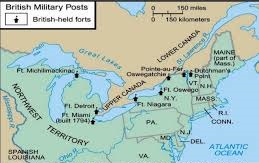
government failed, however, in asserting its authority against Great
Britain. Great Britain, unlike Spain, granted the United
States a
favorable boundary settlement (with Canada) in the treaties which ended
the Revolutionary War—but then failed to honor the treaties by
evacuating its forts which lay on the American side of the boundary
(see map). The British offered, as justification, that
American
state governments were also violating the treaty by making it difficult
or impossible for British citizens to recoup debts owed to them by
Americans. Congress had no authority to force the states to comply, and
the matter carried over into the Washington administration.
The government
also failed in dealing with the infamous Barbary pirates
from the lands which are now Algeria, Tunisia, and Libya.
Algerine corsairs seized an American merchant ship in 1785,
and held the crew for ransom under deplorable conditions. All
of the
Barbary states (except Morocco) demanded substantial tribute payments
to allow American commerce in the Mediterranean, knowing that the
alternative of war would be (for the Americans) even more expensive.
The Confederation government had neither the money for
tribute
nor the navy for war. The captives languished in slavery,
American ships avoided the Mediterranean, and these problems also
carried over into the Washington administration and beyond.
Sources:
Journals of the Continental Congress,
Volume 31; Letters of
Delegates to Congress, Volume 2; Albert Bemis, Pinckney's
Treaty: A Study of American Advantage from Europe's Distress, 1783-1800,
1926; Norman Graebner, Foreign
Affairs and the Founding Fathers, From Confederation to Constitution,
1776-1787, 2011; Samuel Crandall, Treaties:
Their Making and Enforcement, 1924; Kathleen DuVal, Independence Lost: Lives on the
Edge of the American Revolution, 2015.
©
2020 Clionic Enterprises | Back
to Home Page |